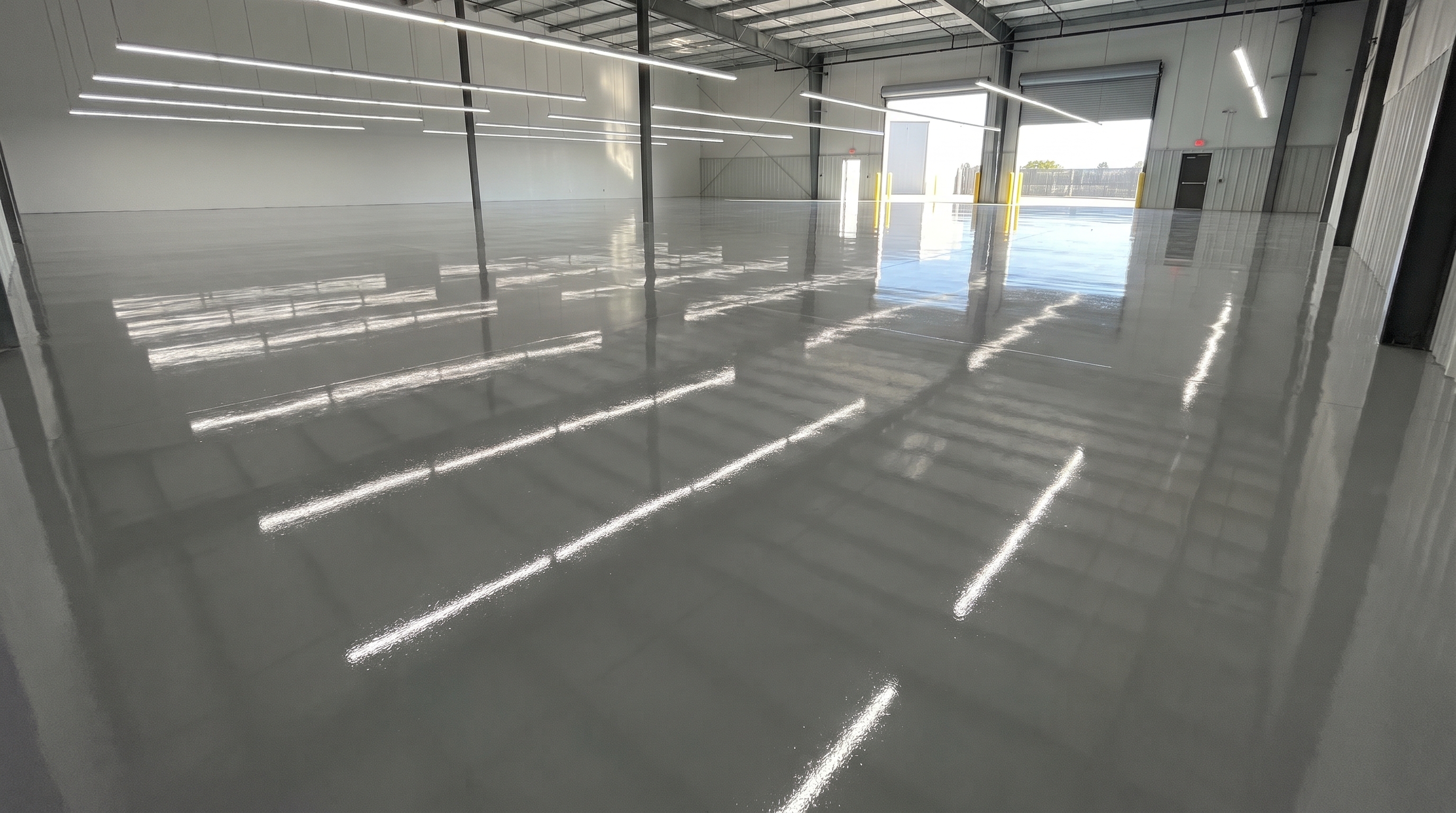
When commercial property managers and industrial operators evaluate options for protecting concrete substrates, they must choose between retail box-store kits and commercial-grade resin systems. The term "epoxy paint" is largely a consumer marketing designation for thin water-based or low-solvent hybrids. In contrast, commercial-grade 100% solids epoxy represents heavy-duty, high-build floor protection engineered for demanding environments.
In commercial environments subjected to regular vehicular or industrial traffic, thin-film coatings often fail prematurely. These premature failures incur significant financial penalties, including the cost of mechanically grinding off the failed coating, repurchasing materials, and enduring operational shutdowns that frequently exceed the initial cost of a professional installation.
What is a 100% Solid Epoxy Floor Coating?
A 100% solid epoxy floor coating is a zero-solvent thermosetting resin engineered from active epoxy resins and specialized hardeners that transforms entirely from a liquid to a dense, cross-linked polymer matrix upon curing. Unlike retail products that rely on evaporating water or volatile organic compound (VOC) solvents to dry, 100% solids systems contain zero evaporative carriers.
Because 100% solids systems experience virtually no evaporative shrinkage during cure, commercial epoxies retain their full applied wet thickness, delivering high mechanical strength capable of withstanding heavy vehicular traffic, industrial forklifts, and severe chemical exposure.
Material Chemistry & Physical Properties
Understanding the chemical composition and dry film thickness (DFT) of these coatings clarifies exactly why DIY kits fail under commercial traffic while professional systems endure.
Solids Content and Shrinkage
Many consumer-grade coatings rely on water or VOC solvents as carrier fluids. As these carriers evaporate during curing, the remaining film shrinks significantly, leaving a thinner protective layer. In contrast, commercial 100% solids epoxies contain no evaporative solvent carriers. According to Sherwin-Williams High Performance Flooring, the applied liquid resin reacts fully to form a dense, durable solid polymer matrix with minimal to zero VOC emissions.
Dry Film Thickness (DFT) Metrics
Lower-solids formulations yield thin dry film thickness (DFT) once carrier solvents evaporate, often leaving only a fraction of their applied wet volume. Because 100% solids commercial systems do not lose volume to evaporation, a single coat delivers a high-build protective layer, while multi-coat commercial systems can be tailored to much greater overall thickness based on facility load requirements.
Surface Preparation: The Acid Etching vs. Diamond Grinding Debate
According to standard industry guidance from protective coating organizations like the International Concrete Repair Institute (ICRI), the majority of resinous flooring failures stem from inadequate surface preparation rather than defects in the coating material itself.
The Failure of DIY Acid Etching
DIY box-store kits typically rely on citric or muriatic acid for chemical etching. Acid etching reacts with surface cement paste to produce a very light profile (CSP 1), but it fails to achieve the deeper ICRI CSP 2–3 required for heavy-duty commercial coatings. Furthermore, acid etching cannot open dense power-troweled concrete, nor can it penetrate existing sealers or deep oil contamination, leaving a bond breaker beneath the coating.
The Necessity of Planetary Diamond Grinding
Commercial installers utilize mechanical diamond grinding equipped with dust extraction to prepare concrete slabs. Mechanical grinding removes old paints, sealers, and weak laitance while opening the concrete pores to achieve an appropriate ICRI concrete surface profile. This mechanical profiling creates a strong physical anchor, allowing high-solids epoxies to bond deeply so that bond strength typically exceeds the tensile strength of the concrete substrate itself.
Direct Analysis of Common Failure Modes
Facility managers must understand the thermal and mechanical stresses that destroy thin retail kits in commercial environments.
Hot Tire Pickup: Vehicle tires generate significant friction heat during operation. When parked on thin or weakly cross-linked coatings, combined heat and wheel weight can soften the coating binder. As the rubber cools, it contracts and bonds to the softened film, peeling it away upon driving off. Fully cross-linked 100% solids epoxies provide superior thermal resistance and remain stable under routine vehicle loading.
Delamination via Moisture Vapor Transmission (MVT): Moisture vapor migrating upward through concrete carries dissolved alkalis that can degrade susceptible adhesive bonds. Without proper moisture assessment and mechanical profiling, rising vapor creates osmotic pressure that delaminates unmitigated coatings. Professional installations require pre-application moisture testing and, when elevated moisture is present, specialized moisture vapor barrier primers.
UV Degradation (Ambering): All standard epoxy chemistries—both retail kits and commercial 100% solids epoxies—naturally yellow or amber when exposed to ultraviolet light. To prevent discolouration and surface chalking, commercial specifications cap epoxy base coats with highly UV-stable aliphatic polyurethane or polyaspartic topcoats.
Facility Downtime and Total Cost of Ownership (TCO)
For active commercial operations, the facility downtime associated with flooring installation often outpaces the contract price. As noted by commercial flooring specialists at National Epoxy, a distribution center that cannot ship or a plant line that cannot run incurs extreme daily losses.
Solvent-Evaporative Coatings: Formulations that rely on solvent or water evaporation generally require extended drying and full cure windows before accommodating vehicle traffic or heavy loads.
Commercial Resin Systems: Curing schedules for commercial systems depend on chemistry and formulation. While standard 100% solids epoxies require defined cure intervals for foot traffic and heavy vehicles, incorporating rapid-cure polyaspartic or hybrid topcoats can significantly compress return-to-service timelines for time-sensitive commercial operations.
Financially, lower initial material shelf prices can be deceiving when evaluated against total cost of ownership. Premature coating failure introduces secondary expenses—including mechanical removal of failed material, repeated product purchases, and extended facility operational downtime. Commercial resin systems involve higher upfront material and labor costs but offer a significantly longer service life when properly specified, prepared, and maintained.
The Professional Standard: Crosspoint Epoxy's Approach
For commercial property owners and industrial operators across Ontario, mitigating these failure modes depends on systematic preparation and proper coating selection. Professional applicators like Crosspoint Epoxy utilize mechanical preparation techniques tailored to the slab condition to achieve the required surface profile for heavy-duty commercial resin systems.
By utilizing commercial-grade 100% solids resins, high-build coating systems provide elevated film build and long-term durability. Specifying appropriate primer, basecoat, and topcoat chemistries enables facility operators to align return-to-service expectations with operational downtime requirements.
Conclusion
Choosing the best epoxy floor coating for a commercial facility requires looking past initial material shelf prices and evaluating the total cost of ownership, operational downtime, and long-term durability. While box-store DIY kits may appeal to residential hobbyists, the structural demands of commercial environments mandate 100% solids epoxy systems backed by mechanical diamond grinding. By investing in professional-grade chemistry and proper surface preparation, facility owners avoid the costly cycle of repetitive failures and guarantee a seamless, long-lasting floor.